Lineside Details: GSR and CIE Tubular Post Signals

Alan O’Rourke


The traditional material for signal posts was either wood or steel lattice.  However, from the 1930s onwards, several companies tried more modern ideas, typically tubular steel, and these diagrams show the CIE design, including new light-weight metal arms, as opposed to the traditional wood design, with a heavy cast iron frame for the spectacle glasses.  The design may go back to GSR days; the late William South told me he saw the first of these designs of semaphores in the Limerick area in 1938.  The design had numerous variants depending on function and position, with differing heights to suit sighting and clearance, and including brackets, junctions and signals to protect level crossings.  Until recently, these tubular post designs, gradually replacing the older wooden post signals were a ubiquitous part of the Irish railway scene, but with the spread of colour light signalling, they have become something of an endangered species themselves in the last few years.

Diagram #1: GSR/CIE tubular post signal (distant)

Diagram #1: GSR/CIE tubular post signal (distant)

Diagram #2: GSR/CIE tubular post signal (home)

Diagram #2: GSR/CIE tubular post signal (home)

Diagram #3: GSR/CIE tubular post signal

Diagram #3: GSR/CIE tubular post signal

Diagram #4: GSR/CIE tubular post signal

Diagram #4: GSR/CIE tubular post signal

Diagram #5: GSR/CIE tubular post signal

Diagram #5: GSR/CIE tubular post signal


I am grateful to the IRRS archives and Mr Brendan Pender for access to the CIE drawings, which seem to date from about 1956, and permission to reproduce them.

Leave a comment

Filed under Prototype, Scale Drawings

“Nearly Irish”

Colm Flanagan


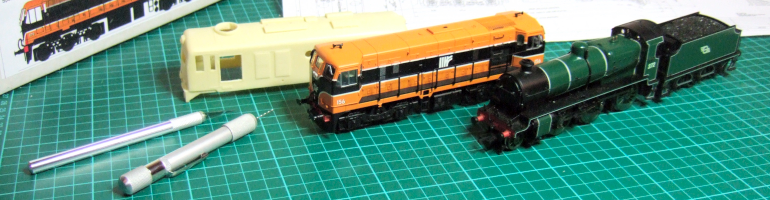
With the arrival of our first really good RTR Irish diesel, and coaches to match by the time this is published, the thoughts of some modellers are beginning to consider whether a steam loco might be viable as a commercially produced model.  If this were so I’d vote for the LMS NCC/UTA/NIR/RPSI Class WT (Jeep) 2-6-4T.  Will it happen; who knows? But in the meantime, are there any ways of getting something like it?  The similarity between the ex-NCC 2-6-4T and its British mainland counterparts has often been remarked upon and in the last few years we have been favoured with Hornby and Bachmann giving us just about all the variants of the LMS/BR “equivalents.”  Over the past few years, as readers of New Irish Lines may remember, I have been building a chopped version of the Hornby Fowler tank which most folk have been very kind about.  New models of the UK 2-6-4Ts have appeared since then, so I thought it might be of interest to do a “state of play” round up, specifically looking at which, if any, of these is closest to the “Jeep.”  There were five variants (that I know of) on the theme:

  1. The original Fowler tanks produced for the LMS.  Modelled by Hornby in the 1980s and ’90s.  A super-detailed version was produced more recently; a renumbered version of this is due this autumn.
  2. Some later versions received side window cabs.
  3. Stanier then produced a variant with a taper boiler, whose dimensions were otherwise the same as the Fowler.  Hornby have recently produced this one.
  4. Fairburn produced a similar locomotive with a slightly shorter wheelbase.  Modelled by Bachmann – still available.
  5. BR produced a standard 4MT tank rather similar to the Fairburn; Hornby Dublo first made a model of this in the 1950s and Bachmann do a model which has been in their catalogue since 2002.

It was between the appearance of 4 and 5 that Ivatt supervised the building of the “Jeeps” – they were possibly designed by Stanier back in 1943 (according to JRL Currie) but building didn’t actually start until 1945.  The first 10 arrived in Northern Ireland in 1946-47, the latter eight 1949-50 (50 was the last actually delivered to the NCC, the rest to the UTA).  So, we seem to have quite a bit of choice.

To begin the consideration, we have to bear in mind certain things.  All of the English locos had wheels 5′ 8″ or 5′ 9″ whereas the Jeeps had 6′ 0″.  The Jeeps had a smaller diameter bogie and pony truck wheel; all of the English locos had longer fireboxes/boilers and shorter bunkers than the Jeeps.  With the exception of the Fowler (1 and 2) they had different wheelbases, mostly between the front pony truck and leading drivers.  Therefore for total accuracy, build your own, or wait in hope for a scale RTR model.  Anyone following either of these approaches may read no further!

Next a major issue: by the time the Jeeps were built, taper boilers were the norm in England, but the Jeeps had a parallel boiler, as it was decided to use the same one as had been used for the earlier mogul tender engines.  On the face of it this rules out all variants except 1 and 2.  However, let us assume that you don’t want to carry out major surgery (and it would be major: I certainly haven’t even tried it!)  Taking the most modern engine first:

The BR Standard 4MT:
Built some years after the Jeeps.  This has side window cabs and a built up bunker which looks reasonably “Jeep-like.”  Also, the front cylinders are high and angled, again, quite good.  This is the only one to have the correct pattern of two steps to the tank undersides, although an early drawing shows the single step on No. 5, the first to be delivered.  This is of course an error as any photographs will quickly show.  There is a continuous footplate, though the Jeep had a cutaway.  However, the “look” of it (whichever version, Dublo or Bachmann, you use) is just too “heavy” in my eyes and that, coupled with the points above, rules it out.

The Fairburn:
The first of which were built in1945, shortly before Ivatt took over as LMS loco superintendent.  Fairburn died suddenly in October 1945 and was replaced by H G Ivatt.  As the BR version has side window cab and bunker, these look more angular than the BR one.  This loco also has a cutaway front footplate.  It has a single step under the side tanks.  Allowing for the points made above, it looks not unlike a Jeep to my eyes.  One slight issue is that there is a definate “kink” in the top of the side bunkers, though this isn’t really noticeable on the model.

The Stanier:
Built in the 1930s.  Side window cab bunker, similar to Fairburn, but with a continuous footplate, similar Fowler frames and the cylinders are at a lesser angle to the horizontal.

The Fowler rebuild:
Built in the late 1920. The good news!  Wheel base dimension is accurate.  Side window cab (though see above); no cutaway on the footplate, and cylinders as Stanier design.  But it has a parallel boiler which is correct, and it’s a bit long overall (as is the original).  If you contemplated doing a small bit of chopping this would get you near with cutting away the footplateand altering the profile of the tank underside, neither a big job.  The bad news: this is the one variant nobody currently makes!

The Fowler original (1926-27):
As above but the cab has no side windows, these have to be cut out and new window frames made, which is what I did on my own conversion; I also cut away the cab and this lengthens the bunker, then did other things, etc. to produce my engines, which take it out of this survey’s remit.

So my conclusion?  If I wanted something “Jeep-like” with no work, just a repaint job essentially, I’d get a Fairburn.  For a little extra work, alter the bunker underside, fit a handwheel to the smokebox (a very Irish thing, that) and repaint, even better.  If you are prepared to do more, than I reckon the Fowler is the better bet to start from.  You’re still left with some compromises of course, but so far that’s the best I’ve come up with.  And if Murphy Models or someone else decides to go for the first proper scale Irish RTR steam loco, my vote goes for a Jeep.  In UTA days they were found on every line still open, they took excursions to Dublin, and in RPSI ownership No. 4 has travelled everywhere in Ireland and still operates today.  The “universal” engine, in a way its builders would never have foreseen.  It could look equally at home with a rake of Cravens coaches of any era, NCC/UTA coaches of Midland style, or the RPSI set.  Of course, if this superbly detailed ultra-accurate WT appeared then I might have some secondhand conversions for sale on eBay!

63 Comments

Filed under Modelling

Getting Started On Soldering: The TDR Three-Plank Wagon Kit

Paul Titmuss


It is evident from discussion that there are a number of modellers who want to progress to brass and nickel silver kits, but are loathe to make the jump because there seems to be nothing for the ‘beginner’ to try their soldering skills with first. I was at this stage once and still find soldering outside my ‘comfort zone’, but am becoming more skilled and increasingly confident, though I don’t profess to be an expert. The Tralee & Dingle three-plank wagon, available from Worsley Works is, I believe, a good starting point. It is low cost (£4.50 + £1.50 P&P), can be used for either 009 or 00n3, and if you bottle out can be stuck together with glue (I have built a wagon using epoxy resin). It is designed to fit the Parkside Dundas Tralee & Dingle van chassis. I am attempting to build Annascaul Station on the Tralee & Dingle Light Railway and whilst there is a lot of stock available from model manufacturers several key items are not catered for, the three-plank wagon being one of them. With the help of published and unpublished photographs (generously loaned by David Rowlands) I drew diagrams for the wagon and sent them to Allen Doherty at Worsley Works, who used them to  create the necessary brass etches for the kit. The best published photograph of a three plank wagon (and one I relied upon heavily in the diagrams) can be found in The Tralee & Dingle Railway by David Rowlands, published by Bradford Barton, p75. By the time of closure each of the remaining wagons had been reconstructed so there were differences between them.

Photo #1: This shows the etch, constructed wagon body and the completed wagon on Parkside Dundas T&D van chassis.

Photo #1: This shows the etch, constructed wagon body and the completed wagon on Parkside Dundas T&D van chassis.

Photo #2: The set up used for soldering. An Antex 25W soldering iron and stand, flux and 145° solder. I do not usually go to the extreme of soldering outside, but on a nice day its quite pleasant, but dont drop any parts!

Photo #2: The set up used for soldering. An Antex 25W soldering iron and stand, flux and 145° solder. I do not usually go to the extreme of soldering outside, but on a nice day it's quite pleasant, but don't drop any parts!

Photo#3: The first job is to tap in the bolt heads. I do this with a pin whilst the brass etch is resting on a piece of hardboard. A light tap is enough. When this is done flux and solder (tin) the insides of both sides and ends. When completed cut the parts out of the fret and clean up the rough edges with a file.

Photo#3: The first job is to tap in the bolt heads. I do this with a pin whilst the brass etch is resting on a piece of hardboard. A light tap is enough. When this is done flux and solder (tin) the insides of both sides and ends. When completed cut the parts out of the fret and clean up the rough edges with a file.

Photo #4: Line up the pieces, ensuring that the outside overlaps the inside section equally at both ends. I have recently acquired some little clips to help. The work is then held in a vice.

Photo #4: Line up the pieces, ensuring that the outside overlaps the inside section equally at both ends. I have recently acquired some little clips to help. The work is then held in a vice.

Photo #5: Flux is applied to the top edge and then solder run along the joint.

Photo #5: Flux is applied to the top edge and then solder run along the joint.

Photo #6: When happy with the join put the side or end on the work surface, inner side up and then apply heat from the soldering iron to help the tinned sides make a better bond. There should be a little solder on the tip of the iron to help with the transfer of heat.

Photo #6: When happy with the join put the side or end on the work surface, inner side up and then apply heat from the soldering iron to help the tinned sides make a better bond. There should be a little solder on the tip of the iron to help with the transfer of heat.

Photo #7: To join a side end place upside down on the work surface. The end piece goes inside the wagon side. Make sure the joint is fluxed. I hold the work in place with Blu-tack®. I also used some fine graph paper to help get the pieces square. The join between the two parts can then be soldered.

Photo #7: To join a side end place upside down on the work surface. The end piece goes inside the wagon side. Make sure the joint is fluxed. I hold the work in place with Blu-tack®. I also used some fine graph paper to help get the pieces square. The join between the two parts can then be soldered.

Photo #8: When both pairs of sides and ends have been joined I then solder up the remaining corners an the basic body shell is complete. You may wish to trial fit the chassis floor at this stage (see photo #11).

Photo #8: When both pairs of sides and ends have been joined I then solder up the remaining corners an the basic body shell is complete. You may wish to trial fit the chassis floor at this stage (see photo #11).

Photo #9: The strapping can then be applied. These pieces can be easily fixed using epoxy resin. If you attempt to solder the straps make sure they are tinned on the fret first, and would be an idea to apply the straps to the work before the sides are built up. The tall end straps are raised from the body and I glued these to strips of plastic card, and then these in turn were glued to the wagon ends.

Photo #9: The strapping can then be applied. These pieces can be easily fixed using epoxy resin. If you attempt to solder the straps make sure they are tinned on the fret first, and would be an idea to apply the straps to the work before the sides are built up. The tall end straps are raised from the body and I glued these to strips of plastic card, and then these in turn were glued to the wagon ends.

Photo #10: The corner plates need to careful bending in a vice. I held them between two rulers and pressed the edge over with a small piece of 1 x 1 timber. On the actual wagon the short edge went along the side so there is no need to panic if the two edges are not the same length. To complete the door straps lengthen the hinge gap by cutting into the etch. Place a fine piece of wire (not supplied) on the edge of the board (with Sellotape®) and press to shape. If the wire has been tinned and the job fluxed this is an easy soldering job. Cut off spare wire and etch before fixing in place. The door straps should just overlap the edges for the door sides.

Photo #10: The corner plates need careful bending in a vice. I held them between two rulers and pressed the edge over with a small piece of 1" x 1" timber. On the actual wagon the short edge went along the side so there is no need to panic if the two edges are not the same length. To complete the door straps lengthen the hinge gap by cutting into the etch. Place a fine piece of wire (not supplied) on the edge of the board (with Sellotape®) and press to shape. If the wire has been tinned and the job fluxed this is an easy soldering job. Cut off spare wire and etch before fixing in place. The door straps should just overlap the edges for the door sides.

Photo #11: The Parkside Dundas chassis can be made up. The floor needs to be carefully sanded to size, a tad off each end (including the sole bars) and a little more off the sides (circa 0.25mm each side) so that the body fits the floor (it might be an idea to fit this before the strapping is applied as a dry run). Dont get too carried away as it is easy to remove too much floor. Next the body is glued to the floor. Vacuum pipes need to be sourced (or those that come with the chassis can be used) plus couplings of choice added to complete construction. It is best to give the brass a coat of etched brass primer before painting and weathering to taste. Hopefully, you have now completed a first successful taste of soldered kit construction. Do remember that if you bottle out with the soldering then the kit can be glued together, so it wont be wasted.

Photo #11: The Parkside Dundas chassis can be made up. The floor needs to be carefully sanded to size, a tad off each end (including the sole bars) and a little more off the sides (circa 0.25mm each side) so that the body fits the floor (it might be an idea to fit this before the strapping is applied as a 'dry run'). Don't get too carried away as it is easy to remove too much floor. Next the body is glued to the floor. Vacuum pipes need to be sourced (or those that come with the chassis can be used) plus couplings of choice added to complete construction. It is best to give the brass a coat of etched brass primer before painting and weathering to taste. Hopefully, you have now completed a first successful taste of soldered kit construction. Do remember that if you bottle out with the soldering then the kit can be glued together, so it won't be wasted.

Acknowledgements:
Thanks to David Rowlands for the loan of photographs, Allen Doherty for the preparation of etches and Simon Starr for exchange of ideas.

Addendum:
If anyone has already purchased one (or more) of the three-plank wagon kits there was an error with the original production etch. The right hand door straps are now available on receipt of an SAE from Worsley Works. My third wagon was completed with these.

2 Comments

Filed under Modelling

Fond Memories

A Moyner


The signboard read “Rathmines & Ranelagh,” but although Rathmines was then generally as being what house-agents now describe as being “upmarket” to Ranelagh, the station was never known by any name but Ranelagh.  On any fine Saturday in summer, my father would hand me my bathing costume and a small bucket and then lead the way out through our back gate and to the lane which bordered the railway embankment, to the little wicket which admitted to Mr Walker’s nursery and a short cut to Dunville Avenue where was the station entrance.  Strategically placed outside to attract the custom of small boys was a machine by which for 1d one could emboss one’s name on a short metal strip.  No dalliance with this was allowed in our family while my father bought the tickets: “Return to Shankill please, Mr Carey.”  Mr Carey was the stationmaster, a kindly man who knew his passenger by name, and who was not offended if some over-burdoned mother asked for his help with her luggage up the long flights of wooden steps which led to the platforms.  His office was a snug one, with an iron stove glowing in the winter, and beside the hatch, carefully arranged rows of cardboard tickets for stations from Harcourt St to remote and romantic places like Woodenbridge and Wexford.  Below these was the machine which printed the date on the ticket with an impressive bang as Mr Carey stamped on the pedal.

The subway under the tracks to the down platform was well built with walls of white porcelain bricks into which were set some bearing the inscription “Ham Baker & Co, Westminster, London.”  I often wondered if this was an unusual address for a firm making porcelain bricks.  At the top of the stairs was a wooden partition with a heavy gate where “Andy” the station foreman, as attested by his cap band, checked the tickets and gave warning that the train was coming by banging the gate loudly off the paling.  This noise always caused some excitement because trains from Harcourt St were often full and it was a point of honour to get a corner seat for the half-hour journey.

Under two footbridges and past the allotments where Herton Rd was later built, we were soon in Milltown, a neat little station with a background of fields, over which there was a shortcut to the village.  Immediately, we would be high above the Dodder on the “Nine Arches” with the steaming laundry below and the view upstream to the narrow bridge and curiously named tavern the Dropping Well.  Dundrum was a busy station, larger than others: it boasted a notice “Station for St Columba’s College.”  I wonder if many of the pupils of that distant establishment travelled there by that route?  Between Dundrum and Stillorgan, we felt that we were really getting into the country, with the view to the Three Rocks, as the train toiled up alongside the reservoir, with its cut stone building perched on the embankment.  Hiding at the end was Stillorgan station, always clean and tidy, with its name showing in the evergreen topiary of a tiny box hedge beside the curve  of the granite boundry wall.  On to Foxrock & Leopardstown which could provide real excitement on race days, with horse boxes being shunted from the mainline to the numerous sidings and a dense crowd of race-goers hurrying across the long bridge which led to the course.

A quiet run then past the new houses of Torquary Rd and the lonely “Barrington’s Tower” to Carrickmines, where the blackberry bushes hung thickly over the high walls, and the station was the starting point for walks over the lark-loud golf course to Ballycorus with its secluded mill pond and wind-swept lead mine chimney.

Now came the best scenery of all, the beautiful woods and corn fields at the head of Druid’s Glen with a glimpse of old Tully Church and nearby cross on the skyline.  Then, across the Bride’s Glen viaduct to glide down to Shankill with its arboured gardens and the signalbox from which the telegraph bell tinkled softly to the background of the murmuring pigeons which always nested on the station house.  Our way was across the main road, with perhaps a warning klaxon from an infrequent motor car, then down the beautifully tree-shaded Corbawn Lane with a triumphant cry of “I can see the sea!” as we toiled up the bridge over the Killiney line, then down the broken steps to the beach.  The reason for the bucket became obvious as my father set us to collect white stones for the garden path, for there was no hope of building sandcastles on this stark beach with its foot-torturing pebbles and tiny patches of sand.  After the compulsory swim, some of our time would be spent lazing on the cliff top, from which in recent memory, the railway had retreated because of the encroaching high tides, which had battered downthe magnificent sea wall, great lumps of which still provided some shelter from the goose-pimpling breeze, which always blew on that long stretch of shingle.

Tired, and sometimes unusually sunburnt, we would start for home, perhaps up what is called “the private way” or Quinns Lane, which had a shortcut – a narrow path alongside the track to the station wall.  The up platform, with a background of a field of golden barley, had some little wooden seats built into the sheltering embankment and, far from casual eyes, a well of the cleanest, coldest water anyone knew: it was part of the ritual to drink from it with the folding aluminium cup which was brought on every picnic.  The return journey seemed to be shorter than the outward one, with that awe-inspiring dash between the echoing walls from Milltown, but we could be sure that the train would stop at Ranelagh: ever since that day, which my parents remembered, when an impetuous engine had burst its way through the end wall of Harcourt St station, all trains had to pause there, even the mainline express, giving that normally somnolent place an undeserved importance for a few moments.


[Editor’s note: I am grateful to David Wynne for the above material.  The author, now deceased, used the nom de plume “A Moyner” and lived all his life on Moyne Road in Ranelagh]

Leave a comment

Filed under Prototype

Building BCDR Diesel No. 2

Denis Bates


No. 2 at Ballynahinch (Denis Bates Collection)

When travelling from Dundrum to Belfast in the 1940s, a journey I often did, one of the sights on the journey was of the Ballynahinch branch train. Although sometimes the branch engine was 2-4-0 No.6, more often it was No.2, the Harland and Wolff diesel electric loco of 1933. Looking like a Co, it was in fact a 1B: the front axle was un-powered, and the other two axles motored. Harland and Wolff tried, with a little success, to break into the diesel market in the 1930’s, supplying engines to the LMS. A diesel shunter was supplied to the NCC, and a Bo-Bo, No.28, to the BCDR.  No.2 (originally numbered D1) was their first diesel electric locomotive, and was described in some detail in The Locomotive (June 15th 1933) and The Oil Engine (May 1933) from which the general arrangement drawing is taken.  The engine was rated at 270hp, and could haul 200 tons up a gradient of 1:100 at 16mph. On the BCDR it spent most of its life on the Ballynahinch branch. As it could not provide steam heating, a set of carriages was modified to provide electric heating. On the closure of BCDR’s main line in 1950, it was sent, together with brake carriage, to provide a short lived service between Newcastle and Castlewellan. It travelled south on Sunday 14th January 1950, illustrated in RM Arnold’s book at Crossgar. I recorded it at Dundrum – it must have travelled via Downpatrick station rather than the Loop Line, as it was cab first at Crossgar, and bonnet first at Dundrum.. Eventually it was returned to Harland and Wolff, and was used by them as a shunter in the shipyards.

No. 2 in what appears to be mint condition (Denis Bates Collection)
No. 2 at Dundrum (Denis Bates Collection)

No. 2 at Dundrum (Denis Bates Collection)

The Model: Chassis
When buying Athearn diesel parts for building my Turfburner model (New Irish Lines…), I measured a number of Athearn diesels. I found that the bogie wheelbases of loco PA-1 were the same as those for No.2. This led me to buy an extra bogie. In addition, a set of gears made by the Ernst Manufacturing Co, of Oregon (listed in Walther’s catalogue) enabled the gear reduction to be increased.
Chassis

Chassis

At the time of writing, this loco is not listed in the current Athearn listings, so may be out of production. As with the Turfburner, wheelsets were made up using the Athearn axle muffs, turning stub axles and wheel centres, in conjunction with P4 wheel rims supplied by Alan Gibson. A small Mashima motor and a turned flywheel were mounted on top of the bogie, driving the original Athearn worm wheel and hence the drive train. Leads from the motor were soldered to the chassis side frames, and off the mechanism went. For P4 standards, the centre axle cut outs were filed slightly high to allow the axle more vertical play. The rest of the chassis is composed of the dummy outside frames, buffer beams and footplate. The most distinctive features are the Isothermos axle boxes. These were turned on the lathe, and added to the spring units: I think I trawled through catalogues to find tender springs/axle boxes which seemed closest in appearance. Sprung buffers were again turned.


Body
Body


Body
Body

I originally thought to make the body myself, but eventually asked Joe Magill, who has made some beautiful models of Irish prototypes in both 4 and 7mm scales, to make it for me – so the striking appearance is his. The distinctive louvres were etched to order by Bill Bedford, to artwork that I drew (they now appear in his pricelist). The paintwork is again by Joe Magill.

So No.2 is ready to enter service, when I get some track laid. Baseboards have already been made, and at the moment the thoughts are of the Ardglass branch – either the very simple Ballynoe station, or Ardglass itself, with its turntable and extension to the quay. Ballynoe station still has its full complement of buildings; Ardglass in 2004 had the goods shed, and a very derelict but complete station building.


The Model: Body


9 Comments

Filed under Modelling

CIE Four-Wheeled Bulk Cement Wagons

Robert Drysdale


The four-wheeled cement wagons, or “bubbles” as they are popularly known, are iconic of the modernisation of Irish Railways in the 1960s.  They are continuously popular subjects for modelling, so in this article a few observations are offered with that use in mind.  One hundred and fifty of these wagons were constructed over a period of eight years and most, I guess, are still in service.  The batch numbers are as follows:

  • 25050 – 25069 (1964)
  • 25070 – 25094 (1965)
  • 25095 – 25099 (1967)
  • 25105 – 25119 (1967)
  • 25120 – 25139 (1970)
  • 25140 – 25199 (1972)

The sub-plot of the article is about what information can be extracted from the Worldwide Web.  With the advent of the web and the digital camera many excellent images have suddenly become publicly available representing an unparalleled information source.  Of course, lacking access to the prototype, a lot of “reverse engineering” is necessary to guess how things are.  A list of websites used is given at the end of this article: if the reader is not yet computer-literate then find an internet café, order a coffee and get started!  I started this work in order to gather information for creating a rake of cement bubbles.  The only drawing I had was the one which came with an MIR kit, which is quite good.  Then I started searching the web for photographs.  What became clear quite quickly was that although these wagons may seem to be standard, there are actually subtle differences which reflect the building batches and modifications carried out in service.  These details might seem a bit too trivial for most people, but I believe that a little variation adds considerably to the realism of a rake of standard wagons.  My notes on this aspect are as below.

Detail Variations
Solebars: it seems as though these wagons have been built with the stronger springs and spring-hangers of the later four-wheeled stock, presumably reflecting their load capacity of 20 or 21 tons.  There are many variations of lifting lugs within the class, which may be two, one or none per side and presumably not necessarily the same number on both sides.  Likewise the mounting plate for these lugs may be rectangular, notched or absent and in the latter case various stiffening ribs can be seen instead.

Buffers: two types can be seen on the photographs, both massive parallel items.  One (older?) type has a smaller base plate which fits inside the open channel section buffer beam.  Note that the buffer beam is arranged with the open channel outwards.  The larger buffer is attached to an additional plate welded across the webs of the open channel.  Whearas the larger buffer has a relatively plain housing, the smaller one is lumpy with a distal bulge on each side of the housing and a flat rectangle on the top surface next to the ram.

Axleguards: most of the axleguards are solid plate items, but some photographs show the earlier fabricated type with a triangular opening on each side of the spring.  This can be seen on other wagons of the same era.

Axleboxes: on a few photographs heavily bolted wing-plates can be seen on the side of the axleboxes, while most wagons have plain wings.  Earlier wagons had a plain dished end-cover whereas most of the photographs on the web show the Timken boxes with the characteristic triangular three-bolt end plate.

Unloading Valves: on most photographs, two small yellow-painted handles emerge from holes in the solebar, which control the outlet valves from the tank.  Although the little holes seem to be provided on both solebars, the handles appear on only one side.  I can see no convention as to which solebar the handles should be on, but there seems to be about equal numbers on left and right-handed examples.

Vacuum Cylinder Covers: the cylinders are located at one end of the wagon and protrude slightly above the chassis, necessitating a chequer-plate platform for safe walking over this area.  In a large number of examples this plate has been removed, exposing the vacuum cylinders and chassis, which poses an interesting challenge for the modeller.

Unloading Pipe: at the opposite end of the wagon from the brake system is the unloading pipework.  The main unloading pipe of 6″ diameter emerges from the decking at about 60° and is provided with a loose cover, which may be either cylindrical or rectangular.

It is debatable how much variation in these details can be seen in one rake of wagons.  New wagons would probably have entered service in very uniform condition but over time modifications would have been made and the various batches would have become mingled.

Colour
According to advice gleaned from the Irish Railway Modellers web group, the bulk cement wagons have had three liveries so far.  Initially they ran in a light-to-mid grey, then were repainted into CIE orange and finally many were given the Irish Cement ivory colour.  Of course since the cement is dumped into the top hatch via a loose hose a lot spills over the tank and ditto for the unloading platform.  Given some rain this cakes nicely and holds track dust providing a glorious spectrum of very off-white to brown colours, interspersed with patches of virgin white where the cake has flaked off.  Many tanks show a haze of light brown over the lower half of the tank suggesting track dirt and/or rust.  A competition for the most realistically painted and weathered cement bubble would be in order!

Operating Practice
We are told we should try to run our model railways realistically, so with that in mind it is worth examining the photographs for operational purposes.  I have read various opinions about how many wagons rakes consist of, namely 12 wagons per rake originally later increasing to 20.  Photographs of an unloading operation at Adelaide show the wagons arranged in pairs, i.e. with the unloading pipes towards each other.  Presumably this is to allow the unloading pipes to be transferred easily from one wagon to the second.  However, most photographs show a more irregular order, presumably after some shunting.  Despite the apparent complexity, the air unloading system allows unloading the wagon into a lorry-mounted tank, which must be equipped with a suitable air blower.  Thus a large unloading installation is unnecessary and cement can be delivered at a simple siding – see the example at Waterside, page 66 in Ulster Transport in Colour by Derek Young.

For completeness I should mention my understanding of how the unloading system works, based on the information available for BR’s Presflow wagons.  “Fluidised bed” is common in industry to make a heavy mass of powder behave like a fluid by pumping high pressure air through it.  The bottom of the cement tank is formed into two cones and it seems most likely that compressed air is injected into each via some sort of distributor ring (I’m guessing here) to fluidise the cement in the bottom of each cone.  When the valve on the bottom of a cone is opened, the cement flows out into the large diameter unloading pipe, which emerges up through the decking of the unloading platform and into the unloading hose of the terminal or truck.  The instructions for the Presflow state that the pipe-work must be purged with air before opening the cement valves in order to clear any water which has collected in the system, which seems wise.  Loading is via the large hatch on top of the tank, most likely by gravity and since this is not a closed system, spilllage occurs.

If any reader is able to shed more light on my observations I would be very glad to receive them on merlin-x@online.no.


Reference Websites For Photographs
onirishrailways2.fotopic.net/c948803.html
railsceneireland.fotopic.net/c1365051.html
irishrailciefreightandrollingstockpics.fotopic.net/c1494361.html

[We hope to have scale drawings of these characteristic vehicles in a future issue. Ed]

1 Comment

Filed under Prototype

Book Reviews

William Scott: ‘Locomotives Of the NCC LMS and Its Predecessors’
192 pages, 272 photographs, colour cover, 47 line drawings, maps, tables, etc.
ISBN 978-1-904242-84-0
£25.00.  Published by Colourpoint Books, Jubilee Business Park, 21 Jubilee Road, Newtownards, Co Down, BT23 4YH, Northern Ireland.

The locomotive history of the “Northern Counties” spans over twelve decades, from the opening of the first portion of the Belfast & Ballymena company, down to the end of revenue earning steam in Ireland.  That story encompasses some 187 engines, including a foray into the narrow gauge.  In that period, technology evolved from the little Sharp singles, weighing in at about 21½ tons, to the almighty Jeeps, which, if not quite the last steam engine delivered to Ireland, represent the zenith of locomotive design on 5′ 3″ gauge.

This book is the result of over 2o years of research.  Naturally it will stand as companion to Norman Johnston’s history of the GNR(I) locomotive fleet, but in comparing the two volumes, you end like Balaam’s ass, gazing from one to the other, and deciding that they are both very good!  They do however take a different perspective.  Norman’s book was a real mechanical archaeology, digging up the sort of details of primeaval engines I never expected to see in print.  Bill, I suspect, does not have this option, since many of the NCC archives were destroyed in the Blitz.  He does however provide a comprehensive record of the “mechanical dark ages” based on what has survived and some detective work by RN Clements.  However, he draws heavily on his friendships with the men who built, maintained, drove and fired these machines, now sadly a dwindling band.  In this respect, his book will never be bettered, and the extra space allows him to provide more operational details for the later period: details of the running and composition of specific services; loco allocation and performance; logs of runs; and some highly amusing anecdotes, gleaned from his time spent in the company of footplate staff.  Moreover, as the author has built several miniature NCC engines himself, I feel his book will have the edge for modellers: it contains scale drawings.  At the end, there are reproductions of 35 NCC weight diagrams for engines and railcars, and the NCC had weight diagrams of the better sort, pretty much scale elevations.  Whilst not quite covering every class, there should be enough material here to keep a workbench busy for a few decades!  Earlier in the book are good reproductions of some of John Houston’s scale drawings, going right back to the Bury and Sharp engines of 1847!  For anyone contemplating building a Worsley Mogul kit, there is a whole chapter of inspiration, a cover picture of 94 in crimson glory, and an unusual and useful photograph of the backhead detail.  Further appendices provide useful details for modellers on livery and lamp codes.

There is also fascinating detail of some innovations which have not previously been published such as early turf-burning experiments and the NCC’s own ATC systems.  There is some humour too: a vignette of Bowman Malcolm, who stamped his mark on Northern Counties design over nearly half a century, and some gentle disparaging of the less competent locomotive policy of a smaller line across Belfast Lough!  For anyone without an engineering degree there are clear explanations about the rationale for superheating and the economic arguments about compounding.  Another useful feature is a periodic standing back from the detail of individual engines, to give a brief summary of the loco fleet at key dates, and compare policy with other Irish railways’ practice.

There are also some interesting notes on the genisis of the Moguls and Jeeps, and, something that is getting rare, some brand new information from the steam age, including details of how the NCC operated a “slip” on the narrow gauge (albeit for an NPC vehicle); various locomotive exchanges with the GNR; and the fact that one of the little DNGR tanks borrowed for shunting in the Second World War got to work a few passenger turns around Coleraine.  Although the book concentrates on the steam locos owned by the “Northern Counties,” for completeness, there are chapters on diesel shunters and railcars and locomotives drafted in from other sections in UTA days.

Some of the early locomotives, despite short lives, moved around a lot, and had complex life stories, but by the 1850s, engineers could produce sturdy machines, with economic lives of upwards of 60 years.  However, most of these engines underwent at least one major rebuild or renewal, and on the NCC it was often hard to tell where an old engine ended and a new one began!  In fact, the NCC was particularly bad among Irish railways for metamorphoses, as 2-4-0s became 4-4-0s, compounds turned into simples, and an engine might have several class designations in its career.  Bill explains all this well: there is particularly good use of detailed tables to show the life history of individual engines, and at last I think I understand the complex history of the A, B, C and D classes, and how a few made the final evolutionary step into the U group!  The photographs include real gems, and reproduction is generally good, allowing for the age of some of the originals.  Many would clearly benefit from larger reproduction to show up small details, but when we are back to the old argument of cost: would you like a few large pictures, or more smaller ones?  Once again, I think Colourpoint have got the balance right here.  Overall this is a wonderful book, and we are very lucky that Bill has put so much effort into pulling all this material together. [A O’R]


Tom Ferris: ‘Irish Railways: A New History’
222 pages, map and 78 plates.
ISBN 978-0-7171-4291-0
€24.99/£19.99.  Published by Gill & McMillan, Hume Avenue, Park West, Dublin 12.

Reading this new volume, I reflect that Irish railway books come in three main types: there are photographic albums; there are detailed technical books or individual company histories (for what Tom calls the “true believers”); and there are books appealing to a wider audience.  A variety of these have appeared since Conroy’s 1928 epistle, a little flurry at the time of the Dublin & Kingstown 150 celebrations, some well written and some not so well crafted.  But it is a while since we have had a generic history of Ireland’s rail network, and Tom is quite explicit that his work is aimed at the general reader, and assumes no knowledge of railway history or operation.  It does however display extensive reading and an encyclopaedic knowledge on Tom’s part.  Anyone already familiar with Irish railways will not, to be honest, learn much fresh.  However, there are some new bits of information: I did not know before that the legislation for the establishment of the joint GNR Board in 1953 empowered the Dublin government to save much of the Irish North-Western in 1957, and if it had, a Dundalk-Clones-Enniskillen line might even today break up that huge railway desert between Sligo and Derry.

Tom divides his topic into five periods.  The first three chapters cover the primeaval era, down to 1850, but going back before the DKR to the 18th century mineral tramways.  This section makes good use of the 1838 report on railways in Ireland, covers he Irish railway mania and even puts the origin of “five foot three” in a new context as the beginning of parliamentary regulation.  In the second period, covering the next 30 years, Tom covers a lot of ground, concisely and accurately, to show how the vast majority of the commercially viable network was built.  We then step aside for an account of the narrow gauge lines, which, unsurprisingly, does get rather generous cover.  Tom’s third period is the golden age, from 1880 to the outbreak of the First World War, although even in this period the economic performance of Irish railways ranged from moderate prosperity to near bankruptcy.  Most new lines built in that period depended on various fairy godmothers such as the Tramways Acts, direct grants and baronial guarantees, and were often constructed for social rather than commercial reasons, or to pacify Irish politics.  Although he does mention it very briefly later on, I think there is one thing Tom misses here.  From the late 19th century, there was strong agitiation, especially from Nationalist politicians, for some form of state control of the Irish railway network.  the main rationale here was that compared to English lines, Irish ones had little mineral traffic and rather top-heavy management and administrative costs, which brought much higher charges.  Central control was mooted as offering greater efficiency and thus lower freight costs to Irish businesses.  The next period (1914-50) is rather ambivalent: on the one hand the railways, despite two periods of wholesale suspension of services, remained a key part of the national economy, comprehensive both in geographical coverage and the traffic they handled.  On the other hand, their economic performance declined even more, and despite a few local experiments with diesel traction and modern signalling, they sank into technological obsolescence.  By the middle of the 20th century, something clearly had to be done, but the last 50 years the “solution” has bounced between closure, rationalisation, reorganisation and at last proper investment, but delivering an odd paradox.  Irihs railways spent much of their history trying to extract a living wage from a rural economy, carrying just about anything that needed to go from A to B: the last mixed train ran as recently as 1975.  Yet today the system depends on railcars, passengers and a growing commuter traffic.

There is a good selection of illustrations, showing the range of Irish railway activity over some 170 years, including some old favourites in colour for the very first time,but in my copy a few plates are spoiled by poor reproduction.  The other main defect is the lack of a bibliography.  Given that the intended audience may not be familiar with Irish railway literature, a book list (at least of recent company histories) would be very useful for anyone whose appetite is whetted by Tom’s broad overview.

In summary, this book aims to give the general reader an introduction to Irish railways, or to place them in context for the student of economics or history, and it does this very well.  As for the “true believers,” most of us will I think still enjoy Tom’s arguments, even if we don’t quite agree with all his interpretations.  One final but important point, especially for any budding authors: Tom has written in a clear and elegant style, which is very refreshing after much of the unintelligible jargon you get today and shows that you can write competent railway history, which is also good prose. [A O’R]
36 Comments

Filed under Book Reviews