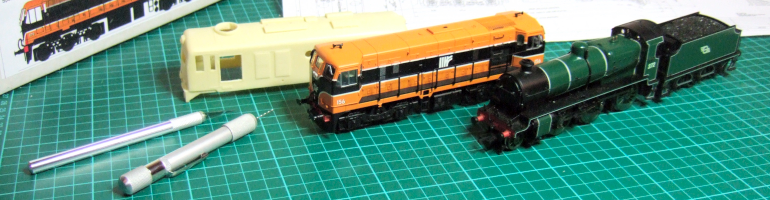
Building a Worsley Works CIE G Class

Jeremy Fletcher


I put together a Worsley Works 4mm etch set of the CIE G-class 0-4-0 diesel for Jim Edgar (“Jim Markle”) who required one for his intended ‘OO’ Irish branch line. The etch set arrived in the usual flat envelope containing the sections laid out on etch ‘frets’.  Resin spring/axle box dummy castings were provided. A nickel silver fold down ‘basic etch’ piece was provided to make the drive/gearbox.   No motor, gears or wheels were provided and it is necessary for the modeller to arrange his/her own.  There are no instructions supplied with the Worsley Works etch sets and it is a good idea for the intending model builder to first study the various parts and decide on the most appropriate procedure to follow. It is a good idea to have as many as possible prototype photographs at this stage.  The G-class kit is one of the more straightforward Worsley Works sets to assemble as there are few complicated double curvatures, although the need for a drive might deter some people.  It provides a good introduction to making  etched brass models.   

Soldering is of course involved in putting the parts together and this may be off-putting to some.  It is not really that hard once you take the initial plunge and get used to it. As this particular model is of a powered locomotive it is advisable at an early stage to decide what sort of drive will be used and how much of the floor must be cut out to give clearance for it. It is easiest to cut out parts from the etchings before starting the assembly.  Cutting them out later can be very difficult and frustrating. I found it easiest to put the G-class together in a series of sub assemblies: cab,  bonnet,  main frame and the drive/gearbox assembly. The upper cab and bonnet are soldered together on the main frame and the drive/gearbox is screwed in place to allow removal for maintenance and oiling.  The cab roof is not soldered on until the cab is soldered in place.  


I started by making the main frame sub-assembly out of the footplate and end and side plates, basically ending up with an open bottomed box.    I first cut out the footplate sheet inside the bonnet area to accommodate the motor I intended to use and also most of the cab floor, being careful to leave enough for soldering on the cab. It is necessary to be careful when cutting out any etching sheet as any stretching of the metal will make it very hard to keep it flat afterward.  It is probably best to drill a series of close-spaced small holes alongside each cut line, break out the piece that is to be removed and then finish off the edges with a fine file.

There are pre-drilled holes to locate the buffers and I enlarged these to suit the  buffers which I made myself. There are also suitable  commercial ones available, such as  Markits  The footplate underside is provided with etched grooves (like those for fold up locations) to locate both the end and side plates.  I first laid the footplate upside down on a flat surface so that it would not distort when being soldered.  I located the end plates in the grooves and held them square to the footplate while running a bead of solder along the join.  I then did the same with the side plates and then soldered the end plates and side plates together.  The side plates also have etched grooves which should be lined up with corresponding ones on the footplate underside.  These are to locate the four triangular side gussets which are soldered on afterwards. I checked that the main frame assembly was true and square before going further.

I next made the cab body by folding around the one piece wall etching to make an open top box.  There are multiple parallel fold lines at each corner to produce curved corners.   I bent the metal around a piece of 7/64” rod to produce even bends. The etch piece edges join between the cab front windows. This joint line will be conveniently hidden by the exhaust stack.  I found that some of the cab window edges which are close to the bends buckled during the bending but were easy to straighten again.  The bottoms of the cab walls have locating tabs which engage with slots in the footplate section.  I checked that the cab fitted properly and soldered it in place.

I made the bonnet section by bending the one piece etch sheet similarly to the cab.  It also has the multiple fold lines to give curved corners although the curved bonnet top has to be bent to look like the photos.  There are outlines on the footplate and cab front to help in getting the shape of the bonnet section right.   The most tedious parts of the bonnet section were the side access door frames and shallow pyramid shape panels. The panels came flat, with fold lines to allow them to be carefully bent to shape. The wire lifting handles on the doors, when inserted in their holes were useful to locate the doors in their correct positions.  I made and soldered in place the handrails for the cab and bonnet sections before going any further.  Ideally I should have used commercial handrail knobs to hold them but could not find any short enough and the handrails would have stood out unrealistically, so I simply bent and inserted the ends of the .019” wire into the pre-drilled holes.  I also made and  soldered in the dummy front and rear marker lights, engine air inlet ‘mushrooms’, sand boxes and the exhaust stack.  I made hand grabs at the front steps from pins.

I fitted the bonnet section in front of the cab, using the outlines as a guide, and soldered it in position.  I then bent the cab roof to shape and soldered it on.  I made the front curved section over the “radiator” grille by filing from plastic which was glued in place after the soldering was all done: of course, there is no actual radiator as the prototype was powered by a Deutz air cooled engine.


I made the drive/gearbox from the basic etch sheet provided, with the axle holes already in place.  It was designed with fold down sides to make a box shape for the gearbox.   The drive/gearbox carries the axles (inside bearings) and the external axle box details are non functional. I found that the gearbox had been designed to suit the P4 ‘Irish’ track gauge and was too wide to fit between wheels set at ‘OO’.  I therefore cut off the sides at the fold lines and soldered them back in position closer together.  As the loco is so small and light it would be barely capable of moving anything with only one axle driven and I therefore made a drive to both axles by means of a gear train, with the motor lying horizontally along the top of the gearbox, inside the bonnet.  I used NWSL 72DP brass gears with an overall speed reduction of 32:1.  The wheels are salvaged from a previous re-powering project.  There was just enough room above the motor in the bonnet for a couple of stick-in lead weights to help traction in this tiny locomotive.  I have not painted the finished locomotive as Jim Edgar wanted to do that himself. 

I put together a Worsley Works 4mm etch set of the CIE G-class 0-4-0 diesel for Jim Edgar (“Jim Markle”) who required one for his intended ‘OO’ Irish branch line. The etch set arrived in the usual flat envelope containing the sections laid out on etch ‘frets’.  Resin spring/axle box dummy castings were provided. A nickel silver fold down ‘basic etch’ piece was provided to make the drive/gearbox.   No motor, gears or wheels were provided and it is necessary for the modeller to arrange his/her own.  There are no instructions supplied with the Worsley Works etch sets and it is a good idea for the intending model builder to first study the various parts and decide on the most appropriate procedure to follow. It is a good idea to have as many as possible prototype photographs at this stage.  The G-class kit is one of the more straightforward Worsley Works sets to assemble as there are few complicated double curvatures, although the need for a drive might deter some people.  It provides a good introduction to making  etched brass models.   

Soldering is of course involved in putting the parts together and this may be off-putting to some.  It is not really that hard once you take the initial plunge and get used to it. As this particular model is of a powered locomotive it is advisable at an early stage to decide what sort of drive will be used and how much of the floor must be cut out to give clearance for it. It is easiest to cut out parts from the etchings before starting the assembly.  Cutting them out later can be very difficult and frustrating. I found it easiest to put the G-class together in a series of sub assemblies: cab,  bonnet,  main frame and the drive/gearbox assembly. The upper cab and bonnet are soldered together on the main frame and the drive/gearbox is screwed in place to allow removal for maintenance and oiling.  The cab roof is not soldered on until the cab is soldered in place.  


I started by making the main frame sub-assembly out of the footplate and end and side plates, basically ending up with an open bottomed box.    I first cut out the footplate sheet inside the bonnet area to accommodate the motor I intended to use and also most of the cab floor, being careful to leave enough for soldering on the cab. It is necessary to be careful when cutting out any etching sheet as any stretching of the metal will make it very hard to keep it flat afterward.  It is probably best to drill a series of close-spaced small holes alongside each cut line, break out the piece that is to be removed and then finish off the edges with a fine file.


There are pre-drilled holes to locate the buffers and I enlarged these to suit the  buffers which I made myself. There are also suitable  commercial ones available, such as  Markits  The footplate underside is provided with etched grooves (like those for fold up locations) to locate both the end and side plates.  I first laid the footplate upside down on a flat surface so that it would not distort when being soldered.  I located the end plates in the grooves and held them square to the footplate while running a bead of solder along the join.  I then did the same with the side plates and then soldered the end plates and side plates together.  The side plates also have etched grooves which should be lined up with corresponding ones on the footplate underside.  These are to locate the four triangular side gussets which are soldered on afterwards. I checked that the main frame assembly was true and square before going further.

I next made the cab body by folding around the one piece wall etching to make an open top box.  There are multiple parallel fold lines at each corner to produce curved corners.   I bent the metal around a piece of 7/64” rod to produce even bends. The etch piece edges join between the cab front windows. This joint line will be conveniently hidden by the exhaust stack.  I found that some of the cab window edges which are close to the bends buckled during the bending but were easy to straighten again.  The bottoms of the cab walls have locating tabs which engage with slots in the footplate section.  I checked that the cab fitted properly and soldered it in place.

I made the bonnet section by bending the one piece etch sheet similarly to the cab.  It also has the multiple fold lines to give curved corners although the curved bonnet top has to be bent to look like the photos.  There are outlines on the footplate and cab front to help in getting the shape of the bonnet section right.   The most tedious parts of the bonnet section were the side access door frames and shallow pyramid shape panels. The panels came flat, with fold lines to allow them to be carefully bent to shape. The wire lifting handles on the doors, when inserted in their holes were useful to locate the doors in their correct positions.  I made and soldered in place the handrails for the cab and bonnet sections before going any further.  Ideally I should have used commercial handrail knobs to hold them but could not find any short enough and the handrails would have stood out unrealistically, so I simply bent and inserted the ends of the .019” wire into the pre-drilled holes.  I also made and  soldered in the dummy front and rear marker lights, engine air inlet ‘mushrooms’, sand boxes and the exhaust stack.  I made hand grabs at the front steps from pins.

I fitted the bonnet section in front of the cab, using the outlines as a guide, and soldered it in position.  I then bent the cab roof to shape and soldered it on.  I made the front curved section over the “radiator” grille by filing from plastic which was glued in place after the soldering was all done: of course, there is no actual radiator as the prototype was powered by a Deutz air cooled engine.


I made the drive/gearbox from the basic etch sheet provided, with the axle holes already in place.  It was designed with fold down sides to make a box shape for the gearbox.   The drive/gearbox carries the axles (inside bearings) and the external axle box details are non functional. I found that the gearbox had been designed to suit the P4 ‘Irish’ track gauge and was too wide to fit between wheels set at ‘OO’.  I therefore cut off the sides at the fold lines and soldered them back in position closer together.  As the loco is so small and light it would be barely capable of moving anything with only one axle driven and I therefore made a drive to both axles by means of a gear train, with the motor lying horizontally along the top of the gearbox, inside the bonnet.  I used NWSL 72DP brass gears with an overall speed reduction of 32:1.  The wheels are salvaged from a previous re-powering project.  There was just enough room above the motor in the bonnet for a couple of stick-in lead weights to help traction in this tiny locomotive.  I have not painted the finished locomotive as Jim Edgar wanted to do that himself.

4 Comments

Filed under Modelling

Locomotive Portrait

SL&NCR 0-6-4T Lissadell in 7mm scale

SL&NCR 0-6-4T 'Lissadell' in 7mm scale

Sligo, Leitrim & Northern Counties Railway 0-6-4T Lissadell in 7mm scale from John Brennan’s collection, a fine scale model running on scale 5′ 3″ gauge, built from the North Star kit.

Leave a Comment

Filed under Modelling

News & Views

Despite the recent increase in our subscription rates, several members included donations with their renewals, and some people said they still consider New Irish Lines as very good value for money. I’d like to thank all those who sent a bit extra, and some of you were very generous. As with  all donations, these sums will go to the newsletter’s general funds. Several folks also commended the quality of the articles in the issues last year, and how they have used some of the information given for their own modelling project, so I would like to pass on these complements to our authors. Please keep the articles coming. We now have about 150 paid up members, but there is always room for more!

Bill Scott has pointed out that the caption on p.31 of the May 2008 issue should of course refer to GNR loco 177.

Peter Swift has reminded me, following on from the article on ballast wagons in the November issue, that Hurst, Nelson  [sorry, my typo] and Company of Motherwell, the rolling stock manufacturers, had no connection with Neilson Reid, the locomotive builders in Glasgow, which later became part of the North British Locomotive Company.

Desmond Coakham writes: 
The article by “A Moyner” in the Nov issue is a masterpiece of  nostalgia. My family moved to Rathmines in 1930, and Ranelagh became our nearest railway station, mostly used for summer trips to Bray, where the council soon prohibited sea-bathing from the sea front and sent prospective bathers on a long walk to a place called Naylor’s Cove. You will know of course that LUAS is driving towards Bride’s Glen and on to Bray eventually*. It deviated from the old DSER line to its terminus and depot at Sandyford, which turned out to be only yards from Stillorgan station on the old line. Denis Bates’ model of poor old D1 looks splendid, but I must tell him they tried it to Ardglass when new and the gradients were too much for it. I am currently sorting out the woeful performance of the Ardglass DE number 28, which they eventually gave back to Harlands and were given a few quid back.
*See Railway Bylines, Annual no 5 for an article by Desmond on this area.

Francis Shuttleworth, who kindly allowed me to reproduce some of his photographs of the GNR drovers’ vans in the May 2008 issue, asks me to clear up any potential confusion, from the note at the end of the article in which  I attributed the collection to “Tim Shuttleworth.” as This  implies, that F.W Shuttleworth collected the photographs, rather than took them, and secondly that “FW” may now have  passed on and that someone called Tim (possibly his son) is in charge of the collection! F.W. and Tim, are, of course, one and the same, and very much alive and well!

While browsing recently, I discovered that there is even a short clip of the Cork & Muskerry Railway in the now quite celebrated  Mitchell and Kenyon collection of early films. I haven’t been able to view it yet, but the details are:
British Film Institute archive: http://www.bfi.org.uk/about/
Use the search option at: http://ftvdb.bfi.org.uk/searches.php and search under “Muskerry”:
Mitchell and Kenyon, 243 ride from Blarney to Cork on Cork and Muskerry Light Railway (1902): Leemount station (fenced, creepers growing up the trellis, a gaslight). To the right is a single rail track and a hill beyond. The camera is at the rear of the unseen train. The train pulls away from the station and passes heavily wooded scenery. There is snow  [sic] on the ground (00.34). A uniformed station worker walking along the track, which is now no longer single. The train passes a truck on the line and two horse-drawn carts on the road at the side of the  track (00.50). A wide road with buildings to the right with signs on the walls, which include `Sunlight Soap’ and `Sutton’s Coal’ [adverts]. Train passes a horse-drawn cart, a tram (marked W.S.10), a bridge and the backs of  gardens or allotments (1.20mins).

The following link takes you to some archival footage of B156 on one of the last regular passenger trains from Cork to Youghal, just at the time  that the green “flying snail” livery was giving way to the early “black  and tan” finish. It’s wonderfully atmospheric, with a “mixed” train, staff exchange at Cobh Junction and footage of some of the intermediate stations. Even that late, Youghal services seem to have offered first-class accommodation: http://uk.youtube.com/watch?v=z4U5MWhTpnM

Another interesting Youtube   link deals with the Waterford & Tramore Railway: no cine film, but a fascinating collection of still shots all the same:  http://uk.youtube.com/watch?v=p8HoJnffb98&feature=related

David Chambers ( davidchambers082@eircom.net ) would be interested to hear from anyone with any further information on the four CIE 30’ six-wheel heating /luggage vans no. 3153-6, introduced in 1964. The only references to come to light on these vehicles are in the Doyle and Hirsch booklets on Locomotives & Rolling Stock of CIE and NIR, a photograph in Des Coakham’s coaching stock book and a short note in Modern CIE Coaching Stock (paper by D Kennedy, IRRS Journal no. 37, p. 159), saying that they were intended for larger winter trains. They were fitted with two Spanner boilers each capable of producing 1,000lb of steam per hour, with 500 gallon water tanks and batteries (which no doubt accounted for their weight of 28tons 5cwts), but which were mounted inside the bodies rather than underneath as on the better known four-wheelers to allow space for the centre axleguards. Each van also had two 160 gallon oil tanks, one under each headstock, Timken roller-bearing axleboxes and a width of 10’ 2”, The body profile, large windows and grab rails seem uniform with the contemporary Craven’s stock, and they had roof hatches at either end. They seem to have been withdrawn sometime between 1982 and 1987. I only came across two specimens, one at Inchicore on a visit in 1982, one on a Sunday morning  Dun Laoghaire-Heuston boat train in May 1980, when I think CIE was suffering a rolling stock shortage and such a service had to make do with whatever was available.

I am also grateful to David for the following website, which gives details of the extension of the Interconnector from Heuston to Inchicore, and includes a map of the proposed Dublin integrated transport network: 
http://www.irishrail.ie/projects/pdf/0904%20DART%20Underground%20route%20maps.pdf

The Irish National Inventory of Architectural Heritage: http://www.buildingsofireland.ie/ includes details of a number of railway structures. In each of the counties surveyed, use the “Advanced Search” option and look under the categories “Locomotive Sheds” and “Railway Stations.”

Following the demise of the MSN site, Irish Railway Modelling has been
re-launched at: http://irishrailwaymodelling.yuku.com/

The following link from the NI Transport Holding Co may be of interest to those who study civil engineering. Scroll down to the fourth message in the string for a spreadsheet listing bridge information on the company’s railway network:  http://www.whatdotheyknow.com/request/bridge_numbers_on_nir_network

Neil Ramsay’s live steam CVR Atkinson Walker built around the Worsley etch features as the Model of the Month for August 2008 on the 16mm Society website: http://www.16mm.org.uk/

David Thom from Ontario in Canada has drawn my attention to the website: http://www.geograph.org.uk/ which includes many photos from Ireland including some of current railway locations.

For anyone having difficulties locating Kinder eggs to make cement bubble tanks from, I am grateful to Jim Hughes of Belfast who has identified an alternative source for the tanks: the covers of toys called Flash Pop Rings (i.e. plastic children’s finger rings with flashing lights). The two main sources appear to be:

Shelton Distributors, Unit 17 Greenogue Industrial Estate, Rathcoole, Co Dublin Tel: +353 1 4018455(1) or
JTS (International) Ltd, Candy House, Crystal Drive, Smethwick, West Midlands B66 1QG Tel: 0121 5521661. 

Recent writings on Irish railways include: 
Berkeley T (2008) Ireland needs a dose of competition [short article on rail freight] Modern Railways 65 (772): 14-15 (Nov) 
Anonymous (2008) New Luas routing at Red Cow [news paragraph] Tramways & Urban Transit  71 (851): 412 (Nov) 
Anonymous (2008) Galway lobbies for light rail [news paragraph] Tramways & Urban Transit 71(851): 413 (Nov) 
Anonymous (2008) Dublin co-ordinates projects [news paragraph new rail and light rail connections] Tramways & Urban Transit 71 (851): 414 (Nov) 
Ferris C (2008) Irish News [Nenagh, Dunboyne and Middleton commuter
services; rail-freight; Dublin smartcard; Interconnector; WRC; new cement  wagons and maintenance vehicles; DART fleet; Ulster funding; rail  funding] Today’s Railways UK 83: 24-6 (Nov) 
Jackson P (2008) Light Rail News [Luas Red Line reopens; weather hits  Luas; Galway light rail] Today’s Railways UK 83: 30(Nov) 
Gray A (2008) Donegal [0-16.5 scale model railway] Railway Modeller 59: 766-7 (Nov) 
Pritchard R (2008) Swansong for Irish Rail loco-hauled Today’s Railways UK 83:46-53 (Nov)
O’Rourke A (2008) Two Irish Models Historical Model Railway Society Journal  19(12):  387-9 (Oct-Dec) [WCIR four-wheel coach; MGWR loco coal hopper wagon]
Anonymous (2008) Metro North moves ahead; Dublin unveils potential 15km LUAS routes to Lucan [news paragraphs] Tramways & Urban Transit  71 (852): 455; 457 (Dec)
Anonymous (2008) Rail escapes budget cuts Railway Gazette International 164 (11): 864 (Nov)
Anonymous (2009) Dunboyne work starts; More trams for Dublin Modern Railways 66 (724): 71 (Jan) [news paragraphs and photo] 
Anonymous (2009) Details for Dublin’s new Luas line to Grangegorman unveiled Tramways & Urban Transit 72(855): 85 (March 2009) [news paragraph and photo]
Anonymous (2009) It’s ‘go’….work to start on Luas extension to Saggart village Tramways & Urban Transit 12(856): 124 (April) [news paragraph] 
Anonymous (2009) Dublin to ban cars from centre to make way for Metro? Tramways & Urban Transit 12(856): 127 (April) [news paragraph]
Anonymous (2009)Northern Ireland academy opens Railway Gazette International 165 (4): 57(April) [short report and  photograph, Translink driver and signalling simulation training facility]
Anonymous (2009) Four bids in Dublin Railway Gazette International 165 (4): 18(April) [news paragraph on tenders for Metro North]
Anonymous (2009) Luas Cherrywood line completed Tramways & Urban Transit 72(855): 87 (March 2009) [news paragraph]
Anonymous (2009) Interconnector still ‘as planned’ Tramways & Urban Transit 72(855): 88 (March 2009) [news paragraph]
Anonymous (2009)Construction work has started on Dublin’s Docklands commuter line; Cuts may affect Irish [Transport 21] schemes; Dublin [LUAS] cars to gain advertising; new Metro West route announced; late  [Christmas] LUAS Tramways & Urban Transit 72 (854): 45, 47, 48 (Feb) [news paragraphs]
Anonymous (2009) Construction work has started on Dublin’s Dockland
commuter line; Galway accesses light rail; Cuts may affect Irish scheme; Dublin cars to gain advertising; New Metro West route announced Tramways & Urban Transit 72 (854): 45; 47 [news paragraphs](Feb)

Allan Doherty has been busy adding to his range of etchings, and recent releases include:

The four GSR built Pullman coaches (see New Irish Lines May 2003): 
* Pullman coach (sides and ends only) 62’4″     £20-00 
* Pullman coach (sides, ends, floor, battery boxes, fold down trussing) 62’4″ £30-00.

Schull and Skibbereen Railway: 
* Passenger brake vans nos. 53 and 54    £15-00
* Goods brake van  no. 46     £13-50
* Vans 36-45  (body including riveted strapping, chassis with brake gear) £9-00 

Castlederg and Victoria Bridge
* No 28 three-plank wagon (later CDR 228)   £13-00
County Donegal Railway
§ Wagon no. 6 (ex-CVBT)    £13-00

Payment by sterling cheques drawn on a UK clearing bank only, payable to  “A Doherty,” to: A Doherty, 19 Douglas Road, Worsley M28 2SR. See the website for details of the full Worsley range of kits: http://www.worsleyworks.co.uk/index.htm Allen Doherty allendoherty@worsleyworks.co.uk

Studio Scale Models has gone on-line since the last edition of New Irish Lines at http://homepage.eircom.net/~studioscale/index.html The site provides full details of the kits with drawings and photos and also order codes for suitable gearboxes, motors and wheels (OO gauge only), which can also be ordered at time of purchase. Various contributors have provided photographs of SSM kits they have built: you may recognize some of them from Alan and Stephen’s Modelling Irish Railways. Thanks to Harry, Eric, Alan and Eamon! SSM are delighted to announce the availability of several new kits. Pride of place goes to the mighty V-Class Compound 4-4-0 Merlin and modellers of the CIE era will be delighted with the trio of Bredin designed first class coach,  composite and mail van (all formerly of the TMD stable). The Victorian six-wheel coaches are also now available separately, good news for those who may want the third class brake with ducket and birdcage roof! All coaches come complete with appropriate seating and transfers. New transfers include the IR/IE Arrow, 2700, 2800 and 29000 IE Commuters, Intercity Mark 4 sets and the DART. Finally, proposed items for development include a Mark 3 EGV etch and transfer pack, and the distinctive Aspinall GSWR D17 4-4-0 loco (as seen
dropping John Wayne off in The Quiet Man). Watch for updates on the new wishlist section on the website and feel free to email or write to: Des Sullivan, Radharc na hInse, Ballybeg, Ennis, Ireland to make your  suggestions for a particular loco, coach, detailing kit or transfer pack.

New release from Alphagraphix include the following 7mm card kits: 
Ballyconnell station (CLR) £12 CC73 GNR Butter van £2 
Florencecourt station (SLNCR) £10  CC74 CIE standard box van (grey) £2 
CC70 Ranks grain hopper wagon (red livery) £2 
CC71 Ranks grain hopper wagon (grey livery) £2 
CC72 GNR Guinness bogie van £4  CC75 CIE standard box van (brown) £2 
CC76 SLNCR horsebox no. 1 (ex-WLWR) £2 
Most of these kits are or will shortly be available in 4mm versions. In 7mm, Roger is also working on an etched brass kit for the MGWR Fairbairn 2-2-2WTs (Elf, Fairy, Bee), with castings to finish. Alphagraphix, 23, Darris Road Selly Park Birmingham B29 7QY E-mail: sirberkeley@tiscali.co.uk

I gather that a company called  ‘Transcale Trains’ have advertised IÉ railcar kits in 4mm scale on the internet at: http://transcaletrains.blog.co.uk/ However, it appears that this maybe a scam: I have heard from some of our members that having accepted some payments, the owner of the website has now stopped replying to messages, and it seems that the models were never actually made.

Marks Models now offer several Irish railway buildings, from the Bachman Scenecraft range: GNR(I) style signal cabin, based on Donnabate, with green woodwork, code: BA44250
Single track loco shed (based on Westport), pale stone finish, with a good deal of soot / oil weathering, code: BA44251 
Single storey stone station building, described as based on Clonmel, code: BA44252. This one  appears closer to one the smaller WLWR stations, like Carrick-on-Suir, but it may be the single-storey section of the main building at Clonmel immediately next to the road overbridge, although the stone finish is also much paler than Clonmel. See: http://eiretrains.com/Photo_Gallery/C/Clonmel/slides/DSC02248.html
Marks Models: http://www.marksmodels.com/?cid=51 or shops at: 14 Hawkins St., Dublin 2, Tel 01 6715809;  339 Dun Laoghaire Shopping Centre, Dun Laoghaire, Co. Dublin,, Tel: 01 2845855;  136 Oliver Plunkett St., Cork,  Tel: 021 4277100 

Paul Taylor sent this picture of GSWR 12-t goods brake, built to HO scale, from plasticard and various items from the “bits box” It runs on Gibson open-spoke wheels and is standing on SMP EM gauge flexible track, which is quite a good match for 5’ 3” in 3.5mm scale (do the maths!). Paul has also built a GSR  bogie rail truck from a Rivarosi FS flat wagon and a two-plank ballast wagon using Slater’s 4mm  body sections on a Lima HO chassis.

HO scale GSWR 12t brake van by Paul Taylor

HO scale GSWR 12t brake van by Paul Taylor

Following on from the article on GNR double-decked sheep vans, it seems that in 1942 the company built ramps for loading and unloading these vehicles at Antrim, Armagh, Ballyroney, Banbridge, Crumlin, Castlewellan, Dromore, Markethill, Poyntzpass, Strabane, Derry, Newry and Maysfields.


From Railways February 1951 12 (2): 29. I havent been able to check the original reference. Could it have been some sort of April Fools?

From 'Railways' February 1951 12 (2): 29. I haven't been able to check the original reference. Could it have been some sort of April Fool's?

2 Comments

Filed under News and Views

Book & DVD Reviews

Hendry R (1999): ‘British Railway Goods Wagons in Colour: For the Modeller and Historian’
Midland / Ian Allan: Hersham ISBN (10) 1-85780-094-X ISBN (13) 978-1-85780-094-4
96 pages, 217 colour photos, glossary, facsimile wagon diagrams (21),lamp head-codes

I have only just acquired a copy of this book, but as it was reprinted in 2003 and 2007, copies should still be available It is a detailed history of the British goods wagon from the days of the small, wooden-framed vehicles up to the 1970′s. I gather that a second volume covers the period 1970-2000, but I have not come across this yet. There are separate sections for general merchandise opens; vans; cattle wagons; tanks; bulk traffic; conflats; bolsters; brake vans; service stock and “special vehicles.” The book is very good on the transitional BR period from steam to diesel and the introduction of block and liner trains. It is in fact a history of freight handling as well as the wagons themselves, with a few bits of social history on labour and union relations included. The Irish content is quite small, and since the author seems rather strict on the geographical term “British” limited to Northern Ireland, but as published photographs of Irish wagons are rather rare, the five shots are still interesting:

p. 5: an ex-BNCR 3-plank open, presented as a late survivor, with many primeaval design features.
p. 6: a more modern NCC van
p. 6: another NCC van but one that quite foxed the experts, being an obsolete Midland (of Derby) design, turned out by LNER shops as a stop gap for service in Northern Ireland in World War Two.
p. 54: Shell Mex & BP tank wagon 271, Adelaide Yard
p. 55: Irish Shell & BP tank wagon 2617 at Grosvenor Road Depot [AO'R]


RJA Pue: ‘Steam Locomotives of Irish Railways’
Published by: the BCDR Museum Trust, 9 Kilbright Rd, Carrowdore, Newtownards. Co. Down BT22 2HQ Tel: 0870 740 9311 E-mail: countydownrailway@yahoo.co.uk

No. 7 The PP Class 4-4-0s of the Great Northern Railway (Ireland) ISBN 978-0-905196-13-8 56 pages £8-95 softback

No. 8 The Locomotives of the Ulster Railway ISBN 978-0-905196-15-2 60 pages, £10-95 softback

The seventh book in this series has now reached one of the more numerous groups of GNR 4-4-0s,the PP class of seventeen engines built between 1896 and 1911, the last scrapped in 1963. As with the earlier books in this series, each of these begins with a brief survey of the class, and then tables of key dates, dimensions and rebuilding. There follows a portrait and “bibliography” for each engine in the class, although much of this information is repeated in summary tables. About half of the book is a photographic album of the class, with a good mix of in-action, on shed and makers’ photographs, spanning the whole history of the class, the various metamorphoses these engines passed through, and with several shots of some of them running in the pre-World War I livery of lined green with name plates. Despite the use of un-glazed paper, reproduction of the photographs is generally good. There is a very diagrammatic outline drawing, which shows dimensions, but which is neither detailed nor accurate enough on its own to support building a model of one of these engines.

The eighth and most recent addition takes a step back in time from it usual format of describing one specific class of relatively modern engines, to review the entire motive power of the Ulster Railway, which lost its independence in 1876. As with such remote periods of railway history, there is little to add to what has already been published, allowing for the gaps in the extant records, and most of this topic has already been covered in Norman Johnston’s detailed history of GNR locomotives. There is a short history of the Ulster Railway itself, followed by a description of its engines, in the form of tables of dates, rebuilding and renumbering of each machine. The author has classified the stock his own way into twenty types. This nomenclature includes two classes delivered during or shortly after the formation of the GNR, and one which did not emerge until 1881 being three rebuilds of older engines into a small class of 0-4-2s.There are some 68 photos in the book, again finding unpublished ones for this period is rather hard, and slightly over a third have already appeared in Mr Johnston’s book, in some cases several enlargements from one of the shed scenes providing illustrations of different classes. The author, however, does find some shots from the FitzGerald Collection which I have not seen before, but as with earlier books in the series, reproduction on un-glazed paper, while keeping costs down, impairs reproduction of some photos.

These booklets are produced as limited print runs, on a subscription basis, with future plans to cover the U2 and W classes of the NCC; the Q, and S classes of the GNR; the DNGR 0-6-0STs; and the Queens. [AO'R]


Jeremy Clements & Michael McMahon: ‘Locomotives of the GSR’
384 pages, 346 photographs, colour dust jacket pictures, 2 line drawings, maps, tables etc
ISBN 978-1-906578-26-8 £35-00 From: Colourpoint Books, Jubilee Business Park, 21 Jubilee Road, Newtownards, Co Down BT23 4YH

Wow! For some time, Southern locomotive fans have cast envious eyes at the Colourpoint histories of the GNR and more recently NCC engines. Well, their own volume has proved well worth the wait At first sight it sounds expensive, but taking account of size and photographic content, it is actually very good value for money. Of course, a book limited to the machines built for or by the GSR would be rather slim, and this covers all the stock inherited in 1925, even if some never carried a GSR number plate. As much pre-group stock had long lives, it is a really a history of locomotives built from about 1880 onwards for the constituent companies. The authors have done their homework very well, and although there may be room for a bit more scholarship on the mechanical dark ages at Inchicore and Broadstone, as regards the post 1925 era, this really is the definitive account. Some material has appeared before, but is well integrated, such as the 1948 summary of each surviving class, a pithy, unsentimental few lines saying what the operating department thought of its antiques on day-to-day basis, and often far removed from dewy-eyed enthusiasts, coming across some ancient engine, or logging a spectacular one off run.

This is of course an era now slipping from living memory, and some decisions may not have been “minuted,” so there has to be a bit of reading between the lines. Here the authors are very perceptive. One problem was that in the newly formed GSR, MGWR men took many of the administrative positions, and to even up the power balance, the chief mechanical post went to Bazin, whereas Morton, your man from the Midland who had already proved himself an astute fellow in spotting bargains off the shelf, had a much more enlightened view on superheating the better older classes. In fact, Broadstone seems to have thumbed its nose at Inchicore on this issue, and quietly finished superheating the 650 class: in 1948 they were about the only Midland engines to get an unqualified thumbs up, the larger 4-4-0s being damned as poor timekeepers on the DSER section.

However, for a company that prided it self on thrift, GSR locomotive practice was decidedly wasteful at times, with each CME determined to produce “something new,” although this lead more to technological vanity than genuine progress. 850, always an engine to provoke partisan views, but the one genuinely innovative design was doomed to be a one off; the 670s were a retrospective step. In fact, Inchicore should have adopted a Darwinian “survival of the fittest” approach to selecting the best of the later pre-group designs: a dozen more 257 class would have been more welcome to the operating department than “improved J15s.” A few more DSER moguls and B4 Bandon tanks would also have been useful additions to the fleet. Maybe nothing illustrates this principle more than the 4-6-0s: the 500s did everything required of them, and more, for thirty yeas, with only minor modifications, whereas the mechanically more sophisticated 400s needed radical and expensive rebuilding to make them efficient engines. The cost of reconstructing them might have been better spent on a few more 500 and Woolwich class engines. The authors even take on the legend of the 800s, suggesting that their main value was boosting morale and for publicity, whereas from mechanical point of view, they were a luxury the GSR could ill afford and minor changes to working practices would have made them un-necessary. But, as the authors comment for much or their period, passenger traffic was actually in decline on the GSR system, whereas goods receipts held up much better, and so, while the company fiddled around trying to produce “fixes” for the Cork mails and the Bray suburban services, it was just as well that it had inherited a fleet of hardy 0-6-0s, which could handle the bread-and-butter traffic.

The photographs are generally well reproduced, just a few for obscure engines are a little soft, and for “spotters” there are good shots of some rather camera shy specimens, like 211, 250, 441, 618 and 621. Sadly, the only scale plans are of two patterns of WLWR tenders, from the Stephenson Locomotive Society book on Robinson’s work: there may be a book of drawings later if there is enough demand (hint, hint!). There are chapters on tenders; the fuel crisis (a detailed account of a difficult time, which bridged the GSR/CIE transition); and a brief account of steam loco policy under CIE (for more details of this period see the Decade of Steam book). Wisely, the turf-burner is left to its own specialised books, but the authors take “locomotive” as a broad term for any self propelled vehicle, so the Claytons, Sentinels (both shunting engines and railcars), Drewry vehicles (broad and narrow gauge) and Drumm trains are all covered. All narrow gauge engines extant in 1925 also feature, but these are well documented elsewhere, and I think the real strength of the book is the detailed accounts of the pre-1925 engines, their rebuilding and modification, and the critical discussion of GSR locomotive policy down to 1940. For the not so technically minded, there is also a very clear and illustrated account of the working of locomotive valve gears and superheating. Finally, the book also includes detailed tables of GSR and GNR returns, which suggest that the GSR was not quite so economically backward as followers of the “enterprising” cross-border line would have us believe! In fact, allowing for the fact that GSR engines and rolling stock were older (and in many cases fully depreciated), the return on capital may have looked even better for the GSR. [AO'R]


DVD: ‘The West Cork Railway  1958, 1959 & 1961 Cameo Memories’ by Brian Baker
Produced and distributed by: Signcraft, Bretby, Burton-on-Trent, Staffordshire DE14 0PS UK Tel. 0044(0) 1283 551581 E-mail: signcraftbretby@aol.com
Running time approx 60 mins Price: £18 including p&p 

Included with this DVD is a section of the 1897 Railway Clearing House Map of southern Ireland showing the west Cork railways, in order to help the viewer visualize the lines depicted.  The reverse side carries additional notes which give mileages for the different sections, a very brief history and a list of books on the  west Cork lines. From the turning of the first sod of the Cork & Bandon Railway on the 16th September 1845, up till the complete closure on the 31st March 1961, the west Cork railways served a large area on the southern coast of Ireland.  The story is recorded in full colour on the DVD with both cine film and still photographs taken in 1958, 1959 and 1961,  and including the final four days of operation, and brings to light some very interesting footage and photographs of the west Cork system.  It also covers the Shannon Vale Mill, showing the working of the line by horse power.  It will be of interest to people who knew the system and people with a general interest in Irish railways, but above all will  be of immense value to modellers of Irish railways as it shows the  many different operations that were typical of the period, including shunting, running, and some beautiful landscape that will inspire modellers of any of the Irish railway systems.

It also includes cab rides for the sections Clonakilty Junction-Ballinascarthy- Courtmacsherry-Clonakilty, Skibbereen-Baltimore and Cork-Bantry. Starting at Albert Quay with steam locomotive No.90 shunting the diesel railcar set, the film takes us through the rural and beautiful countryside that is west Cork, and over some of the best kept track on any railway of the period, as well as over some extremely neglected rails.  The line had the distinction of serving the most southerly railway station in Ireland, and also boasted the first tunnel in Ireland to have steam working through it. The line was worked at this period by diesel railcar sets and C-class Metro-Vick locomotives, with short mixed trains made up of as few as two coaches plus a wagon of pigs, and strengthened on Thursdays by an ancient six-wheeler.  The line also saw excursion traffic as well as loose coupled freight trains which since the 1930′s include beet trains for Mallow sugar factory.  Running through one of the most tranquil scenes in Ireland, this is surely a modeller’s dream railway, with the variation of changing landscape as well as delightful stations along the line and at the termini. There is also an extract of an interview by Brian Baker with 96-year-old Mr. Champion who was a former employee of the railway, man and boy, who recalls some of his railway memories.

The material is professionally produced and narrated by Brian Baker who grew up in west Cork, his father having spent his working life on the west Cork lines apart from a short time at Charleville, and being station master at Clonakilty in the 1930′s. His final appointment was stationmaster at Bandon.  The programme deliberately does not set out to be a source of reference but simply a shared record of a once proud system.

After production and distribution costs, all profit is being donated to the Railway Children charity. [POS]

Leave a Comment

Filed under Book Reviews

Wagon Portrait

CDR Oldbury open in 15mm scale, built by Neil Ramsay

CDR Oldbury open in 15mm scale, built by Neil Ramsay

The wagon uses Slaters 37mm diameter G1 split spoke wheels and couplings, and axelguards from John Campbell.

Leave a Comment

Filed under Modelling

Scale Drawings – Ballymena & Larne 2-6-0ST

Ballymena & Larne Railway Beyer Peacock 2-6-0ST (originally published in Railways, no. 44, Dec. 1943, page 190

Ballymena & Larne Railway Beyer Peacock 2-6-0ST (originally published in Railways, no. 44, Dec. 1943, page 190

Leave a Comment

Filed under Scale Drawings

Table of Contents: November 2008

November 2008


Contents:
 
Editorial – Alan O’Rourke
GNR Hopper Wagons and Plough Vans – Alan O’Rourke
Lineside Details: GSR and CIE Tubular Post Signals – Alan O’Rourke
UTA MED Three-Car Diesel Train – Jeremy Fletcher
“Nearly Irish” – Colm Flanagan
The TDR Three-Plank Wagon Kit – Paul Titmuss
Fond Memories – A Moyner
Building BCDR Diesel No. 2 – Dennis Bates
Station Survey: Abbeyfeale – Alan O’Rourke
CIE Four-Wheeled Bulk Cement Wagons – Robert Drysdale
Scratchbuilding a CIE Cement Bubble – Des Sullivan
Christmas Quiz
Locomotive Portrait: CB&SCR B4 Locomotive – Graham Bridle
News & Views
Book Reviews

Leave a Comment

Filed under Table of Contents