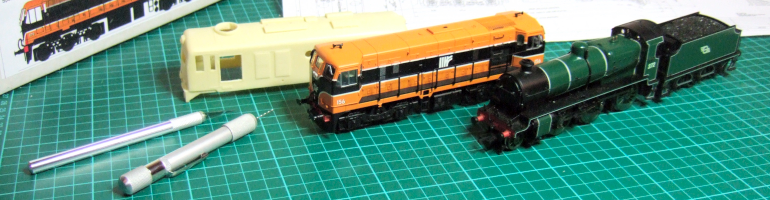
Converting the Murphy-Bachmann 141 Class Diesel to 21mm Gauge

Denis Bates


The General Motors 141 Class diesel of CIE was introduced in 1962, and for over 40 years has been among the most successful of the Irish diesels.  So it was not by accident that Murphy Models chose it for their first foray into a completely designed Irish model (the previous Woolwich Mogul and the NCC Jinty were of course repainted versions of the English models).  So, although my main interests are in steam days, and particularly the BCDR, I couldn’t resist purchasing one, with a view to re-wheeling it to 21mm gauge and P4 standards.  The prototype is described and drawn in two of the model magazines: by Tim Cramer in Model Railways for March 1977, and by Shane McQuillan in Practical Model Railways for June 1986. The latter article describes also the building of one, from a kit by the Model Irish Railways group. Comparing the Murphy model with the drawings, I could find nothing amiss – except for the buffer spacing. The buffer centres should be at a spacing of 6’3”; on the model they are at 23mm (5’9”). I presume that is to match the spacing of other Murphy-Bachmann models, at English spacing.

I first determined that a P4 wheelset would fit between the bogie frames, and it does, just. My main mistake was to dismantle the loco as far as possible – this is not necessary, as the bogie frames can be levered off. They are similar to those of the Bachmann Class 20 diesel (described by Keith Norgrove at http://www.norgrove.me.uk/index.htm). A screwdriver is used to prise out the frames, which appear to be identical on the two bogies. The wheelsets can then be prised out of the bogies. Each wheelset has an offset plastic gear wheel, two brass bearings which are a push fit in the sideframes, and brass wheels with insulating sleeves. Measure the distance of the gear from the ends of the axles, before tapping out the wheels and sleeves using a small drift and hammer. The gear wheel can similarly be tapped off the axle.

If the model is to be converted to EM gauge, all that is necessary is to cut 2mm steel rod to the appropriate length, and put the gear and wheels on. Although there is a spline on the original axle for the gear, it seems tight enough on a plain rod (a smear of loctite could be used to anchor it firmly). To keep the axle laterally in place, two brass sleeves, or an appropriate number of washers, should be added between the gear and the bearings (or between the bearings and the insulating sleeves (see figure). For conversion to P4 and 21mm, the original brass wheels can be used, but have to be turned down to receive P4 rims (these are obtainable from Alan Gibson on special order). It is also possible to turn down the existing rims to P4 standards. For those without a lathe, it may be possible to purchase P4 wheels to suit. Before finally inserting the wheel sets, the pickups need to be adjusted so that they bear on the backs of the wheels. On the Bachmann wheelsets, the hub projects further out than the rim, and does not fit easily between the sideframes. However, the insides of the frames can be filed out (about 0.5mm or more) to give clearance. I used a cylindrical dental burr to do this, held in a drill press, and hand held the frames. Once finished, the loco ran just as well as it had done on 00 track. Now to try it on Adavoyle Junction, out of period though it be!

3 Comments

Filed under Modelling

Something New; Something Old

David Malone


Several modellers have had a go at fitting sound chips into the Bachmann-Murphy 141 although some seem to be using slightly larger speakers than I did. To replace the unusable round one supplied. I did no filing, just snipped the corners off the oblong speaker’s plastic frame, and soldered the wires from the cut off speaker to the new one. I did not know that there were speaker terminals on the lights board. I have fitted my two, black 141 and 181, with Ultrascale wheels, to 21mm gauge. The wheels are intended for the BR “Western” class, and feature protruding hubs. I removed these using a chisel shaped hobby blade, wider than the tyre diameter. They can then be shaved off, using the outer tyre face as a limit stop, a few minutes work per wheel. I had to reduce the supplied axles length by 0.75mm.  The little gear wheel sits on a splined bit of the axle, and slides on the 2mm axle, but a touch of Locktite is all that is needed to secure it. I made the mistake of mounting the gear central on the axle, it should be slightly off set to fully engage the gear in the bogie, I will tweak mine over.  The pick up phosphor-bronze strips need bending out to touch the back of the wheels, and act as a side control spring. Now came the big test, would it run? It worked fine on my 3’ length of straight track, but what about my 5’ length, with a reverse curve 4’ 6” into 4’radius, with rail depression in excess of 1mm staggered in the curve: how would the rigid axles cope? Well, much to my pleasant surprise, they stayed on the track, no problem. Since then I decided to file about 0.5mm off the inside of the side-frames, just to provide a little extra clearance, and reduce the chance of the paint on the wheel disc wearing away.  Looking at the removed wheels, I think the protruding rim of the tyre could be turned off until the tyre is scale width, and then the flange could be turned down to P4 or EM profile, thus avoiding a twelve week wait and the expense of Ultrascale wheels.

Treated and untreated bogies. The untreated one is my CIE Supertrain liveried 181

Treated and untreated bogies. The untreated one is my CIE Supertrain liveried 181

Two versions of the 141 on 2mm gauge track

Two versions of the 141 on 2mm gauge track

I am now doing a bit of weathering on my 141/181s. I overdid the exhaust staining on the roof of the orange one, fortunately using acrylic so it washes off. On the sound chipped ones, I removed the grey bridging plate, and turned the speakers over, so they are face down into the
flywheel void, thus creating a sound box. It does seem louder, even with the hearing aids turned off. A dab of black acrylic on the silver speaker back makes them all but invisible through the grill. The next job is to fit all the plumbing to the “Pilot”, and try to combine the very neat etched coupling links with Exactoscale bits to form a strong coupling. The supplied ones are extremely neat, but I don’t think the little plastic pins would last long in service.

The J15 is finished, at last. I started it in 2006, having had the kit since 1985!!!  I found that the tender spring hangers that I mentioned were on the fret all the time. I thought they were the loops that some tenders had around the springs. A case of read the instructions.  In the RAF and civil aviation, the instructors always gave advice before you went into any written exam: “Read the d*** questions!”  Translated into model building this becomes: “Read the d*** instructions!”

J15 on 21mm gauge track

J15 on 21mm gauge track

3 Comments

Filed under Modelling

GNR Butter Van

Alan O’Rourke


In the days when everything went by rail, some companies found it worth while building highly specialised vehicles for perishable traffics, which attracted premium rates, even if it meant those vehicles must have spent half their time running empty. One such traffic was dairy produce, and the MGWR, GSWR and GNR all built special “butter vans.” In the era before electrical refrigeration, these vans employed various cooling mechanisms like double roofs and  multiple small vents in the body, presumably to make full use of the draft when in motion. I have not seen detailed plans of the internal layout of these designs, but I am guessing that they may have been “double-layered” with ice between two skins of planking, or may have used some sort of system where the evaporation of water from a porous surface (as in the older type of terra cotta milk or wine cooler), by taking latent heat of vaporisation from its surroundings, could effect considerable cooling.  I seem to recall a school physics experiment which demonstrated this phenomenon rather well. It involved bubbling air through ether in a copper beaker, the beaker sitting in a small pool of water on a wooden block. By the time all the ether had evaporated, the whole apparatus was so cold that the beaker was frozen to the block by a lump of ice! Alphagraphix now make a 7mm and possibly a 4mm kit for this vehicle. I am grateful to the IRRS archives and Mr Brendan Pender for access to the GNR drawing and permission to reproduce it.

GNR butter wagon

GNR butter wagon

Leave a Comment

Filed under Prototype, Scale Drawings

Lineside Details: GSWR Mileposts

Alan O’Rourke


Irish railways used a number of methods to mark distances: the symbolic steel sheet squares, diamonds, triangles and arrow-heads of the MGWR were probably the most original design. Other companies used metal, stone or wooden markers. The GSWR used substantial granite mileposts on its original lines, but later, and on the absorbed WLWR routes, used the smaller cast iron patterns shown here.  These diagrams come from drawing in the IRRS archives. I am grateful to the Society for permission to reproduce this and Brendan Pender for his help in accessing the archives.

Quarter-mile marker

Quarter-mile marker


Half- and three-quarter-mile posts

Half- and three-quarter-mile posts

Side and front elevations of the top section of a whole mile marker

Side and front elevations of the top section of a whole mile marker

Side and front elevations upright. Height from bottom surface of base plate to lower edge og the numeral plate is 3ft 4.5in

Side and front elevations upright. Height from bottom surface of base plate to lower edge og the numeral plate is 3ft 4.5in

GSWR stone milepost and cast iron quarter milepost, both from near Nenagh

GSWR stone milepost and cast iron quarter milepost, both from near Nenagh

Leave a Comment

Filed under Prototype

Norwich to… Cultra?

Steve Rafferty


Of all the numerous visits to model railway exhibitions I have made, only once have I been rewarded with sight of an “Irish” layout (Adavolye at Epsom). Putting my faith in providence, my money on a budget airline ticket and my reliance on a relative to provide one night’s sleeping accommodation, on Saturday 15th November 2008 I travelled to the Ulster Folk & Transport Museum at Cultra to see the ‘Friends of Cultra’ model railway day. I was in search of something Irish, and I was not disappointed. There were thirty-three layouts and stands to view amongst the magnificent setting of the main hall at the museum. The “hook” for many younger visitors was no doubt “Ffarquhar,” the very original Thomas the Tank Engine layout built by the late author of the books. There was a wide variety of other layouts, British, American and Continental themed, all of a very high standard, but as my quest was for something “Irish,” it is these layouts that I wish to comment on. 

For me personally the most interesting layout was “Killagan” (OO gauge). Why? I trust our fellow member Colm Flanagan will not be offended if I say it was a “basher’s” delight. I have no skill when it comes to working with kits or etched brass, etc. Therefore I tour the swap- meets looking at second hand carriages with a view to “now what could I hack that into?” The standard of Colm’s work I consider both exceptional and inspirational. The sight of the Mogul and the Jeeps hauling near ‘true’ UTA stock, as well as the MPD’s, the MED and the ‘Class 70′ set, all running in a credible Irish setting, were on their own worth the trip. It demonstrated to me just what can be done with proprietary coaches and a flair for imagination to achieve a real “Irish” looking product. Did I mention the “North Atlantic” set – delicious!

For the narrow gauge enthusiast, Alan Gee’s “Donegal” (OOn3 gauge) is a must see. The very accurate replication of Donegal town station and the CDRJC trains is complemented by the moving road vehicles system which forms the back drop. This year’s show was the first outing for the North Down MRS’s “Ballymoney” OO gauge layout, featuring not only a credible representation of the original broad gauge station, but also the 3’ Ballycastle Railway. Moving to a larger scale, Norman Bailey and John Pollock’s layout “Ardkrowin and Duncluchan Town” (O gauge) was impressive. While Duncluchan Town is fictitious, Adkrowin is loosely based around the layout at Ardglass as it was. Another ‘first outing’ was Paul Green’s “Kilbrandon” (S gauge),  an exceptional example of not only going “Irish”, but back to a time before any of us were born – April 1900. The layout is inspired by and based on Killorglin on the defunct Valentia Harbour branch, with the addition of an imaginary branch line to increase operating interest. The whole layout (mainly scratch-built) is to a very high standard.

A simple yet entertaining layout was the South Dublin MRC’s “Rosslare Strand” (OO gauge). The end section scenarios, especially the Bray Head one are a demonstration of how three distinct scenes can be accommodated within the strictures of a small (-ish!) layout. Another small, yet interesting, layout on show was Jim Poots and Gareth Hutchinson’s “Slieveroe” (OO gauge), based on an imaginary border location in modern times. Moving back to the narrow gauge, “Ballynure-Doagh” (OOn3 gauge) is a commendable effort by the Ballyclare High School MRC. Although not built as an “Irish” layout, “Ballyrichmond” (OO gauge) is a layout built by the Model Railway Society of Ireland as a Southern Region branch line. However,  with the use of some Irish rolling stock and a few judiciously placed features, I think it just about succeeded in masquerading as an Irish location. Lastly it is fair to say I was in awe at the superb modelling standards demonstrated by the (static) display of 7mm scale models built by Messers Mulholland, Aspinwall and  Crockart. Shame they were not actually running. Together with all the above, Allen Doherty of Worsley Works and Des Sullivan of Studio Scale models were on hand with trade stands. A very large selection of Irish railway books was also on sale.

Was it worth it for just one day and a return air flight? You bet. I, for one, will be attending next one. My thanks to those exhibitors, especially Colm and Ian, who took time to answer my questions, and to the Friends of Cultra I say: “well done.”

Leave a Comment

Filed under Modelling

Something a Bit Bigger…


I am grateful to Neil Ramsay for these photos of his wonderful 15mm scale model of CDR  six-wheel saloon no 1. The bodywork is cut from plywood, built up in layers to produce the panelling, the  use of real wood in this scale gives the  effect of the grain, and imparts more ‘atmosphere’ to the model. The axle-guards were gravity cast (from Neil’s masters) in white metal by John Campbell, who also provided the lamp-tops.

The interior is fully detailed, always a good idea for saloon stock, and especially in the larger scales. The internal mirrors are cut from old CDs with real French-polished woodwork and carpeting from dolls’ house wallpaper. The dining chair is a dolls house model in 1/24th scale, with a new seat from Das modelling clay. They are not really proper scale models of the originals, but give the right ‘feel’ when looking through the windows.

The chassis is built with  simplified Cleminson units,  a mixture of home made components  and sprung bearing assemblies from Ron Grant. The centre wheel assembly is shifted sideways by the linkage to the outer wheels. The problem in a model like this is trying to achieve maximum lateral movement of the centre wheels, as this determines the minimum radius (just about 5’) it will go round.  Springing greatly improves the running: in fact Neil’s  six-wheelers run better than bogie coaches and suffer less from buffer lock as the ends don’t stick out so much on curves. Wheels are Slaters gauge 1 split-spoke 37mm diameter. Neil recommends  Slaters 31mm diameter spoked wheels for the 2’ CDR and LLSR wheels. These wheels are coarse scale G1 and work really well in the garden.

Leave a Comment

Filed under Modelling

The UTA’s Finest Train

Colm Flanagan


My story of this train goes back to late 1966, when I was a boarding pupil at Coleraine Institute. Going home for the occasional weekend pass, we boarders were gathered as usual on the down platform at Coleraine Station one Saturday morning. The train from Londonderry came into view way down the line, having curved off the Bann Bridge. By now the UTA had repainted quite a few MPDs into red and white, so as the train approached I assumed it was one of these leading the set. However, as it got closer I heard a distinctly un-MPD sound, a deep rumbling throb, then the train swept past me and I had a glimpse of a large, greenish engine behind the windows of the leading car. Clearly it was not an MPD. The seating was high backed with grey and red upholstery which definitely looked superior and a welcome change from the rather drab green upholstery of older trains. Then we had a glimpse of first class compartments, with seats trimmed in blue, as the train slowed. The restaurant car was an old friend, 550 (ex UTA diner 87, now repainted red and white to match the rest). At the back was another power car rumbling like the leading one. I thought, as did others at the time, “My, it’s a NEW train!”

The completed six-coach set

The completed six-coach set

That was my first glimpse of the trains which I consider the best diesel train that the UTA put into service and certainly a candidate for the best diesel trains in Ireland to date. We knew them as “DEs” – the term “Hampshire” was used by some others more attuned to the GB scene, because of course the power arrangements were the same as used on BR’s Southern Region.  The power unit was a chunky EE four-cylinder generator driving electric motors on the power car rear bogie.  They never reached the very high speeds an MPD on a good day could do, but they were definitely a “proper” modern train with the lighter panelling inside and very comfortable modern seating;  the ride wasn’t the best at the back of the power car and the vibration there was high –and remained so to the end of their lives. You can still experience it for a while (slightly muted) on the NIR class 450 DEMUs, which are now the last of their kind in public operation in the UK. In the un-powered “trailers (there was a first / brake, restaurant and two thirds, all compartment stock), the ambience was similar to that of an LMS or BR Mk1 express train. Later the power cars received names of “Rivers” under NIR and they lasted until the mid-eighties when the bodies were scrapped and dumped and the power units taken to Derby for re-use in the Castle / 450 class.

I’d built a number of 4mm model MPDs and a three-car MED train previously, and these have been covered in New Irish Lines. But I’d always liked the idea of doing a DE set. The question was how? During research for my book on UTA diesels I came across some articles, photographs and a few drawings (of the power car and 87/550) and from these I decided to build a six car set as two of these sets operated the principal services on the ex NCC main line.  The power cars were something of a challenge. They were 63 feet long, with side ventilation grilles in the power compartment. With these, sundry doors and a unique front cab; there was no chance of a simple bodge here. The SR trains, although mechanically similar, looked very different. I had, however an old three-car Lima Class 117 DMU and realised that the under frames of these, suitably hacked by getting rid of most of the engine bits underneath, would do. In the case of the DE trains, the rather large Lima pancake motor isn’t a problem; it’s no bigger than the real engine was! Indeed, in the dummy car I built a plastic card “engine”; I have since acquired a 4mm model of the EE power unit from a firm called Southern Pride, but haven’t got round to fitting it yet. From memory these engines were a greeny/grey shade when new.

72 and 711

72 and 711

548 and 701

548 and 701

The sides of the two power cars were made from the same source as my MPD/MED models, panels cut from Hornby LMS Stanier coaches and then glued together – “cut and shut”.  SE Flushglaze windows improve them no end. Charlie Petty at DC kits provided underfloor etches, roof exhaust panels, and sundry grilles from his SR DEMU kits: beware if fitting the grilles, make sure you use butanone glue as the normal plastic weld glues won’t hold them.  In fact, I had a problem too with the Lima bogies when I tried fitting a plastic card yaw damper/shock absorber (or whatever it was) that is prominent in photos of the EE bogies. I couldn’t get them stuck as the Lima plastic is slightly flexible. In the end I got a useful tip which was to use a combination of MekPak and Evostik. This worked well. The bogies were not a BR design and I have not seen anything like them on any other model to date.  I lowered the bodies on the under frame as they seemed to sit too high:  this is an awkward job on the power bogie and quite easy to make a mess of. A better, though more expensive way of doing the under frames might be to take a Mk1 coach under frame and fit a Black Beetle power bogie.

Under construction

Under construction

Under construction

Under construction

Then I had to build those cab fronts. I used sheet plasticard and cut the windows out, then glued them to the sides and made the rounded edges with filler. The headlamp housing was made from part of a plastic tube filled and sanded down to shape, quite a fiddly job. But once painted the whole thing looks rather well. The train is a little narrower than scale, I think, judging by end on photos, but I can live with that, as it runs on 16.5mm track anyway! Painting the fronts was also quite tricky, I cut curves into masking tape (I prefer the Tamiya product) to reproduce the swooping lines of the livery.  Arguments rage about what colour was used precisely: I just used BR “blood” and white. The crest that adorned the front of these trains for the first year or so of their lives, I’d love to have, but can’t figure out a way of doing it – yet. Anyway, some of them ran briefly without any insignia on the front before the NIR one came into regular use.

After all that the trailers were relatively easy. I’d originally thought I would simply respray two Hornby brake ends and two composites, but when I started looking at the trailer coaches in a bit more depth (there’s an excellent photo of one of these in Des Coakham’s book on Irish broad gauge coaches) I realized, that, not for the first time, the UTA ones were quite different in some respects. The first/brake (701) had only four compartments and  being first class they were of course considerably wider than second class. I modelled mine by cutting panels out of the Hornby composite and the brake end to get close to the correct layout. The all second class ones had both lavatories at one end, similar to the slightly earlier Cravens coaches on CIE, rather than one each end, as BR and the LMS had arranged them. So I had to do some switching of a few “panels” around to get them near correct also. The good news is that they are correct length – viz. 57’.  For that reason I modelled the rebuilt restaurant car 548; this had been a 1924 built NCC coach and worked with the MPDs in original form. The first six car set got 550 (ex-87), a 60’ coach, when the second DE set entered traffic there was need for a second restaurant car. The North Atlantic diner had worked with the MPDs, but was not fitted or refurbished for use with DEs, presumably because with its totally different window pattern, a complete rebuild would have been needed and it was just deemed not worth it.  So 548 was re-skinned and given a look that matched the other coaches quite closely.

The finished product

The finished product

So that is it, for now.  I still have to apply numbers and someday will get round to it. This train, like its prototype, has been quite a favourite with the public when it has been shown on our UTA era layout “Killagan”. Someday I may re-engine it with a smoother newer power unit, and I would quite like to fit sound modules when someone does one with that wonderful distinctive throbbing beat I remember so well. Which might mean looking at DCC…but that will be another story.  I am building a new layout partly based on Coleraine in the 1960’s, so I’ll be able to re-create the moment I referred to at the start of this article, in my own home, one of the great delights of this hobby of ours.

The finished product

The finished product

1 Comment

Filed under Modelling